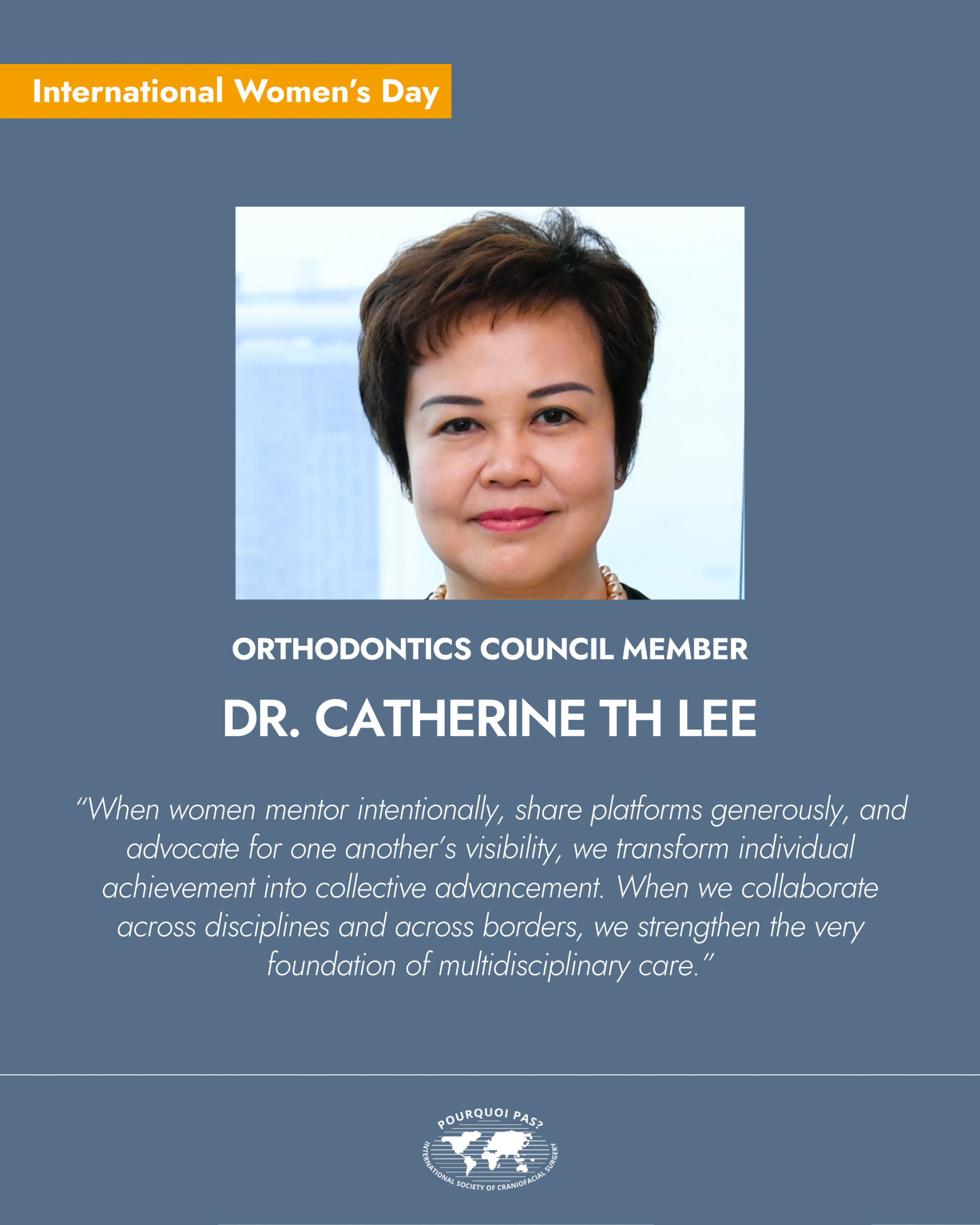
On the occasion of this year’s International Women’s Day, we interviewed ISCFS Council Member for Orthodontics, Dr. Catherine TH Lee, about her experiences and her professional journey.
You are an inspiration and set an example of what women can achieve in craniofacial surgery.
What has empowered you over the course of your career to stay persistent so that you could develop into who you are today professionally?
Catherine Lee: What has sustained me throughout my career is a deep love for the work itself. Craniofacial orthodontics is never routine. The diversity and complexity of cases continuously stimulate me intellectually and spiritually. Each patient presents not just a clinical challenge, but an opportunity to rethink, refine, and grow. I have always believed in pushing beyond traditional treatment boundaries. Integrating evolving technologies — from 3D digital workflows to artificial intelligence — allows us to improve precision and expand possibilities for our patients. Innovation keeps the field dynamic, and it keeps me evolving as a clinician.
Who was/were your mentor(s) and who are you grateful to for their support along the way?
Catherine Lee: I was privileged to train under extraordinary mentors who shaped not only my technical foundation, but also my philosophy of care and sense of professional responsibility.
I am deeply grateful to Dr. Barry Grayson, Dr. Joseph McCarthy, and Dr. Court Cutting in New York. They were true pioneers — the first in the world to perform distraction osteogenesis in the craniofacial skeleton, to develop nasoalveolar molding combined with gingivoperiosteoplasty, and to pioneer the early integration of 3D surgical planning in craniofacial reconstruction, as early as the late 80’s. To train in an environment where history was actively being written — where entirely new surgical frontiers were being defined — was profoundly transformative.
I still remember Dr. Court Cutting telling me upon completion of my fellowship:
“You stand on the shoulders of giants — now the future of craniofacial orthodontics is in your hands.”
In that moment, I understood that the baton had been formally passed — that I was entrusted to continue the work where they had left off. He gave me his blessings to carry the field forward. It marked not just the completion of training, but the beginning of stewardship.
I also owe much to Emeritus Professor S.T. Lee of Singapore General Hospital and Professor T.C. Lim of National University Hospital, who gave me the opportunity to work alongside them and to explore the boundaries between disciplines together. Through our collaboration, I learned how integrated craniofacial care truly evolves — not in isolation, but in partnership. It has been a deeply meaningful journey.
I remain especially grateful to retired Dr. Barry Grayson and Professor S.T. Lee — not only as mentors, but as lifelong friends whose influence continues to guide my work.
What has been one of the most significant challenges you’ve faced as a woman in craniofacial surgery, and what did that experience ultimately give you in terms of growth or perspective?
Catherine Lee: While I have always believed that competence and integrity ultimately establish credibility, some of the deeper challenges I encountered were shaped not only by gender, but also by race.
As a racial minority in the countries where I grew up, trained, and worked — Adelaide, Sydney, New York, and across Asia — I became aware of the subtle and sometimes unspoken ceilings that can exist. Being both a woman and a racial minority meant navigating cultural differences, preconceived expectations, and, at times, not being immediately taken seriously.
In competitive professional environments, structural barriers can be present — sometimes subtle, sometimes overt — including gatekeeping around highly sought-after roles. These realities are rarely discussed openly, yet they are part of the landscape many navigate quietly.
Rather than discouraging me, these experiences strengthened my resolve. They deepened my resilience and sharpened my sense of purpose. I learned to allow my work to speak consistently and to build credibility through contribution, not confrontation.
Most importantly, I was supported by what I often call “angels” along the way — mentors and colleagues who recognized my potential and believed in my ability to make a difference. Their support reminded me that while barriers may exist, so do allies. And allies make progress possible.
Beyond personal challenges, there is also a broader professional one: craniofacial orthodontics remains under-recognized, even within orthodontics itself. It is a rare subspecialty with limited structured training pathways worldwide. In many settings, surgeons and orthodontists have not historically trained together, making multidisciplinary integration more complex.
Working across diverse healthcare systems — from highly resourced institutions to underdeveloped environments — shaped me into a more versatile and adaptive clinician. I learned to modify treatment approaches, optimize available resources, communicate effectively with surgeons, and strengthen team cohesion.
Our role extends far beyond aligning teeth. We help refine surgical sequencing, simplify reconstructive stages, and support the overall success of the multidisciplinary team. That perspective was not developed in comfort — it was forged through challenge. And for that, I am grateful.
How can women benefit from being ISCFS members?
Catherine Lee: Craniofacial orthodontists, particularly women, are often few within their institutions and even fewer within global leadership spaces. Through ISCFS, they gain access to an international, multidisciplinary platform where their expertise is recognized, their perspectives are heard, and their contributions help shape the direction of craniofacial care worldwide.
ISCFS is not merely a venue for attending meetings. It is a space to lead discussions, influence standards, contribute to global guidelines, and strengthen interdisciplinary collaboration. It enables women to step into visible roles — as speakers, educators, mentors, and decision-makers.
By participating actively, women do not just benefit from the network — they help define it. They contribute to the evolution of training pathways, research priorities, and team-based care models.
In that sense, ISCFS becomes more than a society. It becomes a platform for leadership, advocacy, and long-term impact on the future of Craniofacial orthodontics & Craniofacial surgery.
#GivetoGain is this year’s theme. What advice would you give to women who are at the beginning of their craniofacial orthodontic careers? And for those who are more established and seeking leadership positions?
Catherine Lee:
For Young Craniofacial Orthodontists:
Be intentional about your presence. Attend ISCFS meetings. Participate in webinars. Stay intellectually engaged.
Craniofacial orthodontics is a demanding subspecialty that requires humility, discipline, and courage. Be willing to take on complex cases. Be prepared to invest extra hours. Mastery is not built in comfort — it is forged through deliberate effort and sustained commitment.
Use the network wisely. Seek mentorship actively. Ask thoughtful questions. Observe how multidisciplinary teams think, communicate, and make decisions. Technical skill is essential, but understanding collaboration is equally critical.
And above all, cultivate gratitude.
We stand on the shoulders of giants — and those giants must be acknowledged. We are beneficiaries of decades of research, innovation, and unwavering mentorship. None of us arrive here alone. Gratitude keeps us grounded, sharpens our sense of responsibility, and reminds us that excellence is inherited, refined, and ultimately passed forward.
For established Craniofacial Orthodontists seeking leadership:
The global shortage of craniofacial orthodontists — even in highly developed healthcare systems — is not simply a workforce concern. It is a call to stewardship.
Leadership is not defined by title or visibility. It is defined by multiplication.
If circumstances allow, establish fellowship programs and build structured training pathways that will outlast your own career. Sustainable growth requires intentional cultivation.
If a formal fellowship is not feasible, meaningful leadership can still take many forms:
- Organize focused workshops that transmit both technical expertise and clinical reasoning
- Deliver lectures locally and internationally to broaden exposure
- Engage actively in interdisciplinary conferences
- Welcome visitors to observe your clinics and team dynamics
- Offer short-term attachments or sustained mentorship
Even opening your doors can profoundly influence a young orthodontist’s trajectory. When we invest in others — formally or informally — we expand access to care, stimulate thoughtful research, and elevate standards across regions. Personal expertise becomes collective advancement.
The subspecialty grows when knowledge is transmitted with intention and generosity. That is #GiveToGain — as mentorship, as responsibility, and as legacy.
What is one lesson you intentionally pass on that you wish you had learned earlier?
Catherine Lee: Find your team early.
Craniofacial reconstruction is not a single procedure — it is a shared journey that often unfolds over many years. In many cases, we grow alongside our patients, guiding them through stages of development, reconstruction, and renewal. Such continuity cannot be sustained by individual expertise alone.
Technical mastery is essential, but it is only the foundation. True craniofacial care is built on trust, clear communication, and mutual respect across disciplines. When a team is aligned in purpose, extraordinary outcomes become possible. When alignment is absent, even brilliance struggles.
Choose collaborators who share your vision. Nurture those relationships deliberately. Grow together through complexity and challenge.
In this field, enduring partnership transforms treatment into lasting impact.
What does the theme #GiveToGain mean to you in the context of your orthodontic career?
Catherine Lee: To me, #GiveToGain reflects the rhythm of craniofacial care.
To patients:
When we give fully — our time, thought, planning, and commitment — we gain something immeasurable: the fulfilment of restoring function, dignity, and confidence.
To the profession:
When we give by training new craniofacial orthodontists — especially in underserved regions — we expand access to care. More trained specialists lead to stronger research, deeper interdisciplinary collaboration, and more advanced treatment possibilities.
Giving is not loss. It is investment. What we share strengthens the field.
How can women collectively use the principle of #GiveToGain to shape the next chapter of craniofacial surgery?
Catherine Lee: #GiveToGain means lifting as we lead.
When women mentor intentionally, share platforms generously, and advocate for one another’s visibility, we transform individual achievement into collective advancement. When we collaborate across disciplines and across borders, we strengthen the very foundation of multidisciplinary care.
Every opportunity shared expands access. Every door opened multiplies possibility.
When women give — through mentorship, excellence, and courage — we gain a stronger, more inclusive, and more forward-looking craniofacial community.
And just as we once stood on the shoulders of giants, we now become the shoulders upon which the next generation will stand.
That is how the next chapter is written.